Showing posts with label Kerala. Show all posts

Saturday, 20 December 2014

A shack by the beach

Looking north from the end of the lane
My room at Asinmomo
I planned a week in Edava, 5km north of Varkala. without any specific agenda. I wasn’t interested in mixing with the international back-packer crowd, and I certainly didn’t want to mingle in with the middle-class European families looking for a different Christmas climate. 

I just wanted a cheap, clean room, WiFi and some simple food. Asinmomo “homestay” was just what I was looking for. 
Tropical workspace
The “homestay” idea is all over India. 


People have an annex they rent out to guests, or a spare bedroom. At Asinmomo, the family lives in accommodation on the flat roof, while the ground floor comprises four bedrooms, each with a simple, en-suite bathroom. 

The kitchen is a separate building a few yards away, there’s a wide “sit-out” verandah and, with the addition of broadband access and WiFi, the whole creates a simple, money-generating operation.

St Augustine of Hippo

I have hardly moved from the verandah for the past 5 days. I have resurrected the writing I did over a year ago, and started to make some sense of it. 

I know there’s lots of good stuff in there, but it still lacks structure and I have discovered that some of what I thought were my new and revolutionary ideas, were voiced by St Augustine  in the 4th century. 

I wonder if Augustine had the same sense of deflation if he discovered some earlier writer had written something rather similar, centuries earlier.

When I haven’t been researching and writing, I have been extremely lazy. 

I have taken breaks to play some infernal version of Solitaire on the laptop, I have looked up train and bus timetables and I have booked accommodation for my final few days in January. 
I designed a Christmas card and emailed it to friends and family, and I have enjoyed the unfamiliar luxury of an afternoon nap.

Mattindia gave me a physical detox; Edava has given me a mental detox. I should be just about right to start at the monastery / ashram on Monday.

A mild evening, looking out to sea

Tuesday, 16 December 2014

Letting the train take the strain

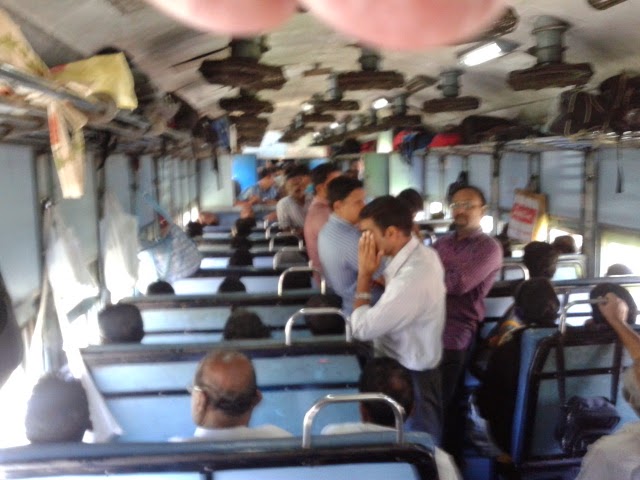
I shall return to Mattindia at the end of my stay, but I am now off for a week at the coast. I wasn’t bothered about lying on a beach; I just wanted peace and quiet to write and rest. It’s a 3-hour train journey to Varkala and I had no idea what to expect. With a 6am start, I needed to be up at 4.30 to take the auto-rickshaw to the station, 5km away, and so it was that I stood at the roadside in the humid night air, hoping the rickshaw driver had not over-slept.
20-0dd coaches and standing-room only
He hadn't, and he greeted me cheerfully. He had taken my much-loved Clarks sandals to be re-soled, and will have them for me when I return to Mattindia next month. The total cost for the cobbler's work and his job in driving around would be £4.92 - so I agreed happily. I was not the first passenger to arrive at the station, and I chatted to a school teacher who was waiting for the same train and continuing further, to a course in Trivandrum. Over the next half-hour more passengers arrived, in an alarming flow, until there were at least a hundred and more on the platform of this remote station in the middle of nowhere.

The ticket office opened and I bought my ticket for the 142 km,(88 miles,) 3-hour journey to Varkala. That set me back 40 rupees (39p) but with no reservation I wasn't guaranteed a seat. Joy, the owner of Mattindia, had told me I wouldn't need a reservation, but then he is about one third my size and with a wig, and without a moustache, he could probably travel for child-fare. 

When the train arrived I rushed to climb aboard but was quickly discouraged: "No, Sir. That is a ladies-only carriage." I charged further down the platform and climbed up to meet a sea of blank faces. There was a seat half-way down and with an extra-big smile, I asked if the place was free. "Reservations," came the reply,"this carriage is for reservations."  And so it was: and so it was for the next four carriages. These seats were reserved for people with pre-booked reservations. Finally, I decided to chance my luck and just sit down and see what happened. The bench-seats are for three passengers, which is fine for normal Indians but not for XXL Brits. Half of me balanced on the aisle seat . . . but it was better than standing.

Indian Railways is one of the world's largest railway networks comprising 115,000 km (71,000 miles) of track and 7,172 stations. Last year it carried more than 23 million passengers daily. I can believe it. The train trundled on, averaging less than 30mph, but it got me to Varkala very cheaply, and there were taxis at the station, vying for trade to take me to my home by the beach.
Arriving at Varkala station

Sunday, 14 December 2014

A visit to the Dentist

Here, in the village, Dr Chippy Thrideep opened the Varuna Dental and Orthodontic Centre just three weeks ago. The road outside is dusty and littered with the inevitable plastic wrappers, and sweet papers but the entrance to the clinic is tiled and I stepped into a haven of air-conditioned comfort.
- it looked like this one in the showroom
My visit stemmed from my annoyance at being charged £35 in Lincolnshire for my dentist to re-fix and cement back one of my crowns that had come loose, and which I just avoided swallowing. He had done a good enough job, but it had taken barely 5 minutes. In a previous visit, his dental hygienist had given my teeth a quick 10-minute once-over with the descaler and polishing brush, and the charge had been £40. A month ago I had looked in the bathroom mirror at home, and seen that my addiction to espresso was staining my teeth badly, and I had decided that while I was in India, I would seek out a clinic that would tackle both these issues.

It was with some trepidation that I had decided to call on the local dentist. I have been staying in Vallyathodu, which barely qualifies as a village. There are just a dozen shops, with merchandise hanging outside on hooks; plastic toys, and cheap dresses, umbrellas and shirts. There is a general store that sells all kinds of agricultural equipment from hoes and mattocks to sickles and winnowing trays. There’s a lovely barber who wears a broad grin as you sit in his enormous revolving chair while he snips away. The price of my haircut was 100 rupees (98pence.)  Then there’s the tea-shop, where old men sip their sweet, milky chai and gossip like Greeks in a Kaphenion or Italians at a bar in the piazza. I had not expected to find a dental clinic, but a colleague at Mattindia had heard that it was recommended.

I sat in the waiting room of the Clinic, scanning the pages of the Kerala equivalent of Homes & Gardens. Only the language differentiated this magazine from any of its European equivalents. There were the same gleaming kitchens with high-gloss cupboard doors and intricate mechanisms for shelves that disappeared into the corner storage. There were vast sofas to accommodate and impress your friends and relations, and there was bedroom furniture that would have graced an oligarch’s seraglio.

After a while I met the dentist. “Hello, I’m Chippy, Chippy Thrideep.” In name and nature, I quickly surmised. Chippy was somewhere in her 20s and had a perfect complexion with huge eyes under perfectly trimmed brows. Her smile was what you would expect from a dentist and, and, um, well – let’s just say that I was confident, for once, that I would enjoy my visit to her clinic.

The consulting room was immaculate. Chippy worked with great concentration, removing any and every trace of coffee and red wine from the dental enamel of my smile. She never nagged me to open wider, she apologised any time the water jet of the ultra-sound touched a sensitive spot, and I just lay back for an hour, admiring the spotlights in the shiny white ceiling.

She gave me strict instructions about letting my crown settle down, and avoiding eating on that side of my mouth, and then she wrote out the bill. Cleaning and polishing, 400 rupees: re-fixing crown, 200 rupees – total 600 rupees. That’s about £5.88.

I didn’t haggle. That smile alone was worth a fiver.

Tuesday, 9 December 2014

Yoga and the Art of Lying Down

I have stayed at several Ayurveda centres, and they all incorporated sessions of yoga in their programmes. But yoga is not something that comes naturally to me. I am not (and never have been) well-coordinated physically. Despite the fact that I rowed in my school’s First Eight at Henley Royal Regatta, I was hopeless at even the fundamentals of gymnastics. I think it broke my father’s heart, since he captained the school football team and also won a silver cup for the cross-country mile.

Yoga, as I have always imagined it - nigh impossible!
Yes, I have always had very negative feelings about my physicality, and it’s been a hang-up since my father first nick-named me “Jumbo” at the age of about three. It was an image I have tried to shed many times, and I decided that on this visit to Kerala, I would make the effort to join the early-morning yoga class and not let my clumsiness detract from my efforts to get some benefit out of the exercise.

Eagles soared threateningly overhead
And so, on Saturday morning, I made my way to the flat roof of the building at 7am, picked up a sponge yoga mat, and stretched out, enjoying the early morning warmth as I lay on my back and watched the eagles circling overhead. For a moment I wondered if they were vultures eyeing me over, but I think they were just Fish Eagles out for an early-morning soar.

The instructor arrived and the first part was easy. Breathing Through the Nose: I can do that. Then we did Standing Still with Feet Together: I pretty much had that mastered after a couple of attempts. We did Hands in the Air, Hands Out Sideways, and Head Turning to the Right and the Left. In a few minutes, I was full of confidence.

After that, things started to get more complicated, but the teacher was skilled at coaching students of a wide range of abilities, so that there was benefit for everyone. It was all about stretching and breathing, and it all made sense. I felt better for it, even if I still felt like the dummy in the class. At the end of the hour, I felt loose and more flexible; by Day Two, my toes were getting closer to my fingertips and I was glad I had decided to join the early morning group.

Arjay and Anand
Unfortunately, I had to change my plans on Day Three and give yoga a miss, at least for a day. The problem was that my two masseurs, Arjay and Anand, had been focusing on my lower back, and since the previous evening, I had been totally unable to move around anywhere, without using a walking stick.

Arjay and Anand are the two top therapists at Mattindia, and they really do know how to “hit the spot.”  Let me describe the fundamentals of Ayurvedic massage.
The massage bench is more than 2 metres long and is one solid piece of hardwood, treated and stained by years of massage oil and other medications. 
Traditional Ayurveda massage bench

I start by sitting sideways, with the two therapists standing one in front and one behind me. While Arjay supports my chest, Anand starts to work on my back, alternating between broad, gentle strokes and moments when he presses his thumbs on my spine and seems to be trying to rearrange the vertebrae. He locates pressure points and I gasp, groan and squeal as he pushes hard into my back. Then they switch roles and Anand supports my back while Arjay takes a turn at being the  torturer and starts to work on my chest, reaching up to concentrate on my shoulders and the side of my neck – both of which have been mildly troublesome for several months.

I then lie on my back while more oil is applied and they start on the full length of my body, switching between long, soothing strokes from my chest to my ankles and exquisite pain as one or other of them decides to work on the sole of my foot, or the inside of my thigh.

Finally, I lie down, covered with a thin cotton sheet while the two guys pour streams of hot, medicated water all over me. It is the most heavenly sensation,  and more than compensates for the anguish of the pressure-points.

I limped away from my session today, but although my back aches painfully, I noticed that my posture has changed and I am definitely walking more upright. Maybe I'll make it to yoga tomorrow.

Friday, 5 December 2014

Travelling and Arriving - the Age-old Journey

Up at four, taxi at five
On Thursday morning in Lincoln, my faithful SONY bedside clock-radio crackled me awake shortly after 4am. Roughly 24 hours later, after a short connection in Doha, my flight landed in Cochin. Taxi, train, tube and planes had brought me halfway around the world to the enveloping warmth of a South Indian morning. 

“Warmth” sums up South India for me. The heat is not stifling, nor oppressive; it’s embracing and comforting. If you fight it and try to be busy and efficient it will taunt you into being irritated, but if you relax into it, it responds like a tropical swimming pool and floats you luxuriously. The other “warm” aspect of being in Kerala is the warmth of the people themselves, who exude a desire to be gentle and helpful, whether or not you’ve met them before, and no matter what the circumstances. When locals call their territory God’s Own Country, it describes the people and their interactions, every bit as much as all the other aspects of the scenery, traditions and culture.

I proceeded patiently through the friendly chaos of the baggage reclaim area and then walked out into a sea of expectant faces. These were the anxious eyes of hundreds of relatives, all coming to meet the warriors, coming home from the war . . .
The expats come home on leave
 Except that in this case it’s the IT engineer back from Germany, or the barrister back from chambers in the City of London, the nurse returning from work in a European hospital,  or the hotel chambermaid, back from working in the 5-star environment of the Gulf.

India is a nation of travellers, moving around the world in search of a better life. They take their traditions and their culture with them, but these are not nomads. They blend their way of life with that of their adopted national identity. In barely a single generation, a new dynastic culture is forged. 
Initially, this way of life stays close to their heritage, but gradually, it merges into a new culture, and in time into a new race. I'm English for many generations, but my roots are in Norman farming, a thousand years ago, before my ancestors crossed the Channel with William in 1066. And for that matter, we all date back to Olduvai Gorge in East Africa, the birthplace of Homo Sapiens.

A few years ago, I was channel-hopping one wet afternoon, and stumbled upon the Welsh language channel of the BBC, which was broadcasting the National Eisteddfod from Wales. I stumbled upon the finals of the children’s country dancing competition. As the children pranced seriously to traditional Welsh melodies, one 11-year old competitor caught my eye. He wore his Sikh turban with pride. Such instances give me hope for the future of a truly multi-cultural society in Britain.

As I left the arrivals terminal, I glimpsed the familiar face and broad smile of Vinu in the crowd. Vinu’s mother is office manager at Mattindia and Vinu – who is studying business and tourism at college in Cochin – works part-time as a private taxi service for Mattindia’s guests. He had driven me around on a couple of occasions earlier this year, and I had swapped copies of my business books on “Negotiations” and “Presentations” for a memory stick of beguiling Kerala music. His courteous friendliness is another kind of Keralan warmth that I find so endearing.

Halfway along the drive back to Mattindia, we stopped for a freshly squeezed fruit juice at a smart café. The dishes on offer included sanitized versions of pizza and Chinese noodles alongside just a couple of Indian classics like Biryani. But no samosas, no stuffed Nan bread, and no dishes from the mouth-watering variety of the Kerala breakfast menu.

This is the downside of multiculturalism. Sometimes, in the race to embrace and adopt new ideas, a culture loses some of its definitive and best-loved elements. In London today, you will find authentic Muslim cuisine on Brick Lane, but you will have to hunt to find the once ubiquitous Cockney delight of Jellied Eels.


Jellied Eels, Pie, Mash and Parsley Liquor - it tastes much better than it looks